Every episode starts from zero
Research, copy, audio, captions, and covers live in different places. Finishing one video leaves the next dependent on memory.
final_v7.mp4script-actually-finalcaptions-to-review.srtcover-change-againRESET
I organized topic selection, scripting, visuals, voice, captions, covers, platform copy, and quality checks into a repeatable AI content pipeline. The goal is not merely to finish one video faster, but to make every episode inherit what the previous one taught me.
The expensive part of video production is not any single edit. It is re-deciding everything for every episode: what to say, how to structure it, what to show, how audio and captions align, and what is still missing before publication. When a dozen steps depend on memory, finishing one video sends the next one back to zero.
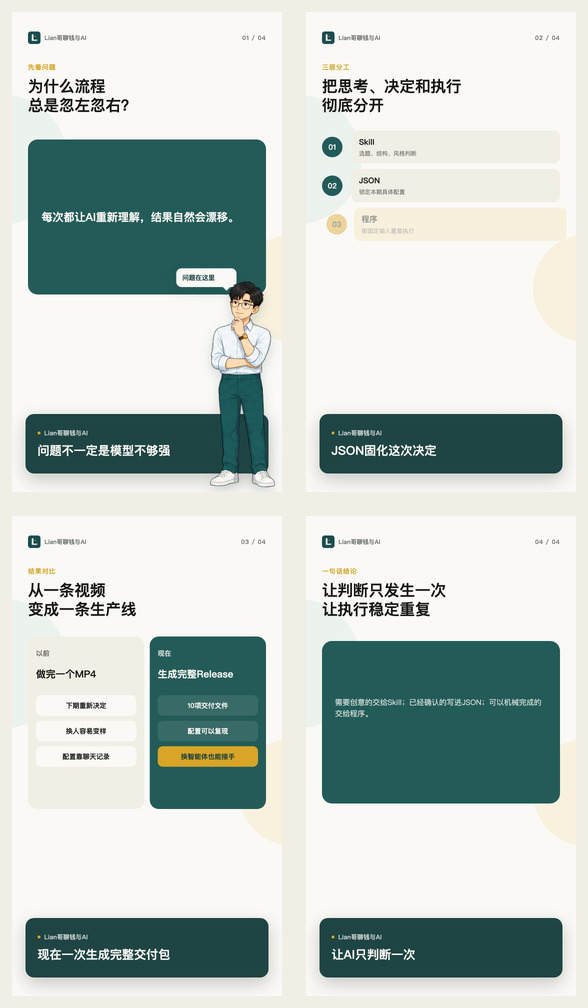
Content is data, components handle expression, and the final voice track owns the timeline. Five stages create a delivery chain that can be checked and reproduced.
Lock the series, audience, single question, and useful conclusion before expanding the script.
Narration, screen copy, scenes, and assets have explicit places. Revising copy no longer means rebuilding the timeline.
Generate one continuous narration track. Real pauses become the timing source for captions and scenes.
The real video enters a preview window while safe areas, loudness, duration, and file parameters are checked.
 00:31:12 / 00:43:24
Video, cover, captions, platform copy, configuration, and QA evidence arrive in one release package.
The division of labor is explicit: skills preserve judgment, the episode configuration carries the content, software executes consistently, and a human makes the final call. AI does not decide what I believe; it handles the repetitive work after the decision.
These are frames from actual renders, not concept art. Structured content, voice, captions, and QA remain consistent while the visual language changes with the subject.
Everything a platform needs is prepared in one release package, with each item open to inspection and traceability.
Research, copy, audio, captions, and covers live in different places. Finishing one video leaves the next dependent on memory.
Judgment lives in the Brief and Skill, content enters the Episode, voice becomes the timeline, and every output lands in an inspectable Release.
From topic to publication, the work no longer breaks into a dozen projects waiting on one another.
The pipeline does not replace creative judgment. It makes each judgment executable, inspectable, and reusable.